The Kept
Its keepers cannot hide a single thing they feel. The salvage crew cutting its way in cannot read any of it.
The thing had a pulse, and Nola Kettering was the only one who said so out loud.
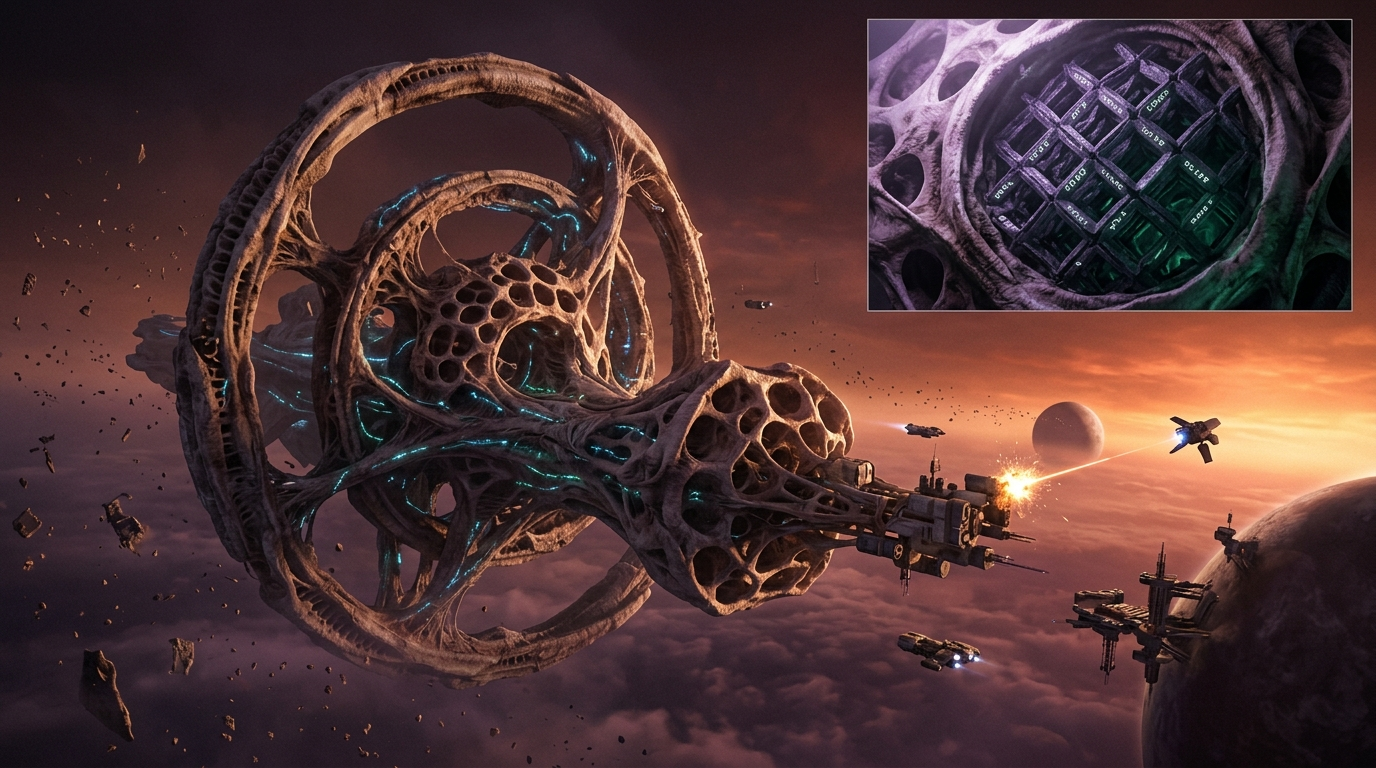
She said it at four hundred kilometers, with the Collier's Due still falling toward it on a long braking arc. From the couch it filled every port. At a thousand kilometers it had been a reef. At a hundred it was the inside of a thighbone, sawn through, all struts and hollows, and Rusk, who flew the Due, had stopped eating at the console. Up close it had no edges a person could name. Struts branched into finer struts and those into a nap of spines, and through every piece of it, deep under the surface like veins under a wrist, ran lines of teal light.
"Thermal," Ida Brannock said. "Sun on one side, heat bleeding round the other. Old hull rings like a bell for a century after the crew's gone."
"It's on the shadow side too."
"Then it's holding heat."
"It's holding time." Nola laid her left hand flat on the port glass, the metal one, and the strip on her forearm drew what the fingertips found: a slow green hill, and a flat, and a hill. She timed it against her chrono. Nineteen to the minute, and at the end of every minute a run of three quick ones down the whole length of the thing, end to end, like something said twice to be sure. "Heat drifts. That doesn't drift."
Nobody counted it with her. The claim was Brannock's. So was the note on the Due, eleven months behind, and so was the name on the salvage filing that called this object a derelict, abandoned, origin unknown. When Brannock said the word derelict her hand went flat to her chest pocket, where the note lived.
Nola tapped her metal fingers on her thigh plate. One, two, three, four. It was a thing the hand did when her mouth had decided to stay shut. The hand felt nothing. It had felt nothing for six years.
At sixty kilometers the three quick ones stopped coming once a minute. They came all the time, the whole reef going bright in a running wave and then dark, and bright again, faster each time.
"Hull stress," Brannock said. "We're close enough to tug on it. Take us in, Rusk."
***
The wall pulled away from the torch.
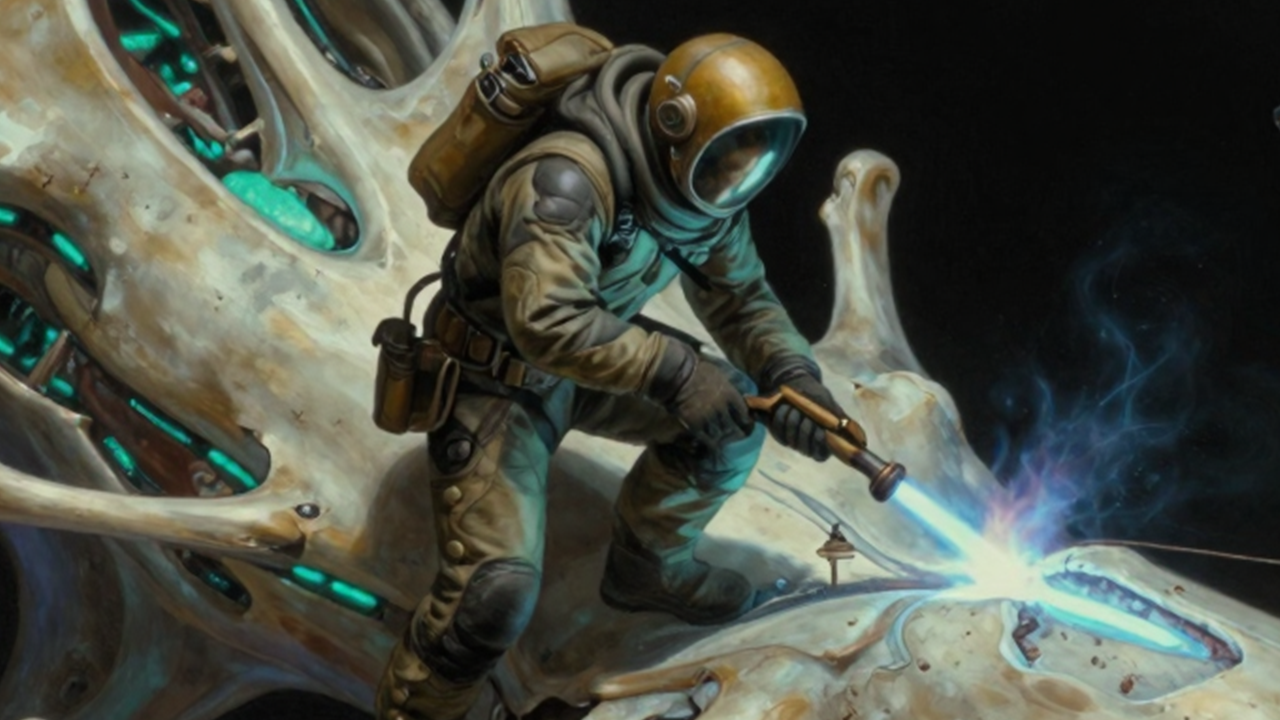
Nola saw it happen from the end of the tether, forty meters off the Due's bow truss, and for a second she took it for the usual thing: plate buckling as it heated, the way hull does. She had cut into eleven dead ships. She knew how metal gave.
This was the color of a tooth, and it didn't buckle. It drew back from the flame a hand's width along the whole length of the cut and held itself there.
"Ida," she said. "Kill the torch."
"I've got four meters to go."
"Kill it a second."
The flame went out. Brannock hung at the cut face with the torch in both gloves and her boots braced on the alien surface, and she didn't turn around, which was how Nola knew she had seen it too.
"Reactor," Brannock said on the suit channel. "Old pump, still turning. That's good news, Kettering. Power's worth more than hull."
"There's no reactor on the scan."
"Then it's something we don't have a scan for. That's better news."
A derelict didn't flinch. Nola had been raised by a grandmother who wouldn't let her walk through the shadow of a sleeping dog.
"Cut slow," she said.
Brannock lit the torch.
***
The burn comes up through the floor into Kthiix's standing foot, and it is in the old bone, the first-grown, where the elders are thickest.
Kthiix does not move. It stands at the ninth cell of the long row with one sole on the floor and the other pressed flat to the cell's face, as it has stood at this cell at the start of every waking since the dimming took the one inside. Through the lifted sole it reads the cell. Through the planted one it reads Leuphana, all of her, every hall, the slow push of the veins. Now Leuphana is saying pain, from far off, in the outer lattice. A small hot mouth is eating in.
They had sung to the small ship. Everyone awake in Leuphana had sung, as the old ones taught: three bright inside the long, down the whole spine, so it could be seen from any side. Here. Here. We see you. The small ship came on without a light anywhere on it, so they sang faster, as anyone would to someone who has not heard. It never answered. It came on dark, and it put its mouth to Leuphana's side.
Leuphana has been struck before. Stones. Ice. She closes over those and goes on. This is not a stone. A stone does not keep on.
Kthiix stays where it is a little longer, because it has not finished here, and the keeping does not stop for pain.
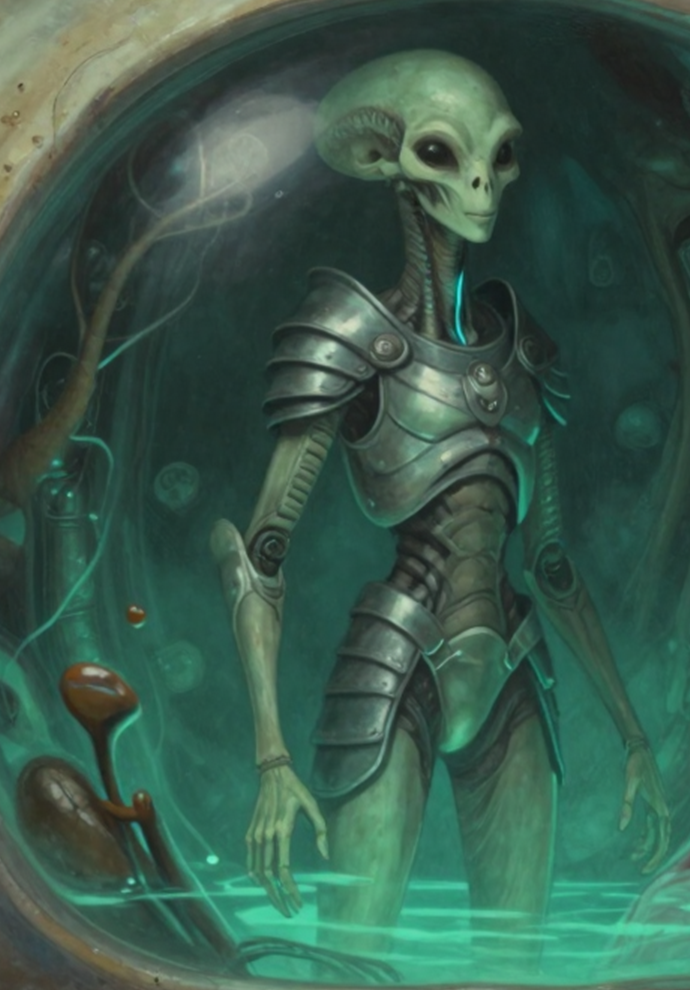
Behind the cell's face, in the green Kthiix's own chest lends it, Vethzyr stands the way Vethzyr always stood: one hand on the hip-plate, head up, sure of the next thing. The dimming caught it standing like that. It caught most of them in the middle of some ordinary act, and the cells were grown around them where they stopped. Vethzyr was bright once. Vethzyr could be read from the far end of a hall, every thought of it, a joke coming two breaths before it arrived. Now the skin is the grey of shed plate from the feet to the jaw, and there is one line left. A thread of blue along the throat.
Kthiix lets its chest go to the pattern. Long. Two short. Long. That is Vethzyr, the name of Vethzyr, the way a hall-mate's name is said across a room. It says the name into the cell and holds its sole to the face and waits.
The line at the throat thickens. A very little. Then it is as it was.
That is all Vethzyr has said in longer than Kthiix can hold in mind. It may mean here. It may be only a thing the body does, the way a cut limb draws up. Nobody knows what the dim ones feel, or whether they feel. That is the whole of the trouble. A person whose light has gone cannot be read, and a person who cannot be read might be dead, or might be standing inside the dark with everything they ever were, saying it and saying it to nobody.
The elders had a word for that, and Kthiix was given it when it was small enough to stand on an elder's foot. The dead can be told any way at all. Only the living can say no, that is not how it was. So nobody is told dead who might still say no.
So they are kept. Each one lit, since they cannot light themselves. Each one named on the face of its cell in a patch of living skin, so the name goes on being said. There are more cells than Kthiix has ever counted in one waking. There were other keepers once. Kthiix knows which cells they are in. It is the last whose chest still burns, and the burn has gone green with the years of lending, the green of the cells. It is a big body, long in the arm, the head heavy as a seed-case. It wears a harness hung with the tools of tending, and its knee pads are worn pale from the floor in front of ten thousand cells.
It takes its foot from the glass.
The pain in the outer lattice stops. A wound stands open there. Through the wound, through the bone of the floor, into the sole of Kthiix's foot, comes a weight. Then a second. They walk in turns, one side and then the other.
They are coming along the hall of the kept, and they have no light at all.
Kthiix's chest floods before it can think. It has no say in that. Nobody does.
***
The tunnel past the cut was warm.
Nola felt it through her suit's thermal read, and the read made no sense, so she stripped her right glove for one second, against procedure, and put her palm to the wall. Warm as a horse's neck. Damp. When she took the hand back it came away tacky and faintly blue.
"Glove on, Kettering."
She put the glove on.
The hall took her breath, and she let it, because Brannock had stopped too.
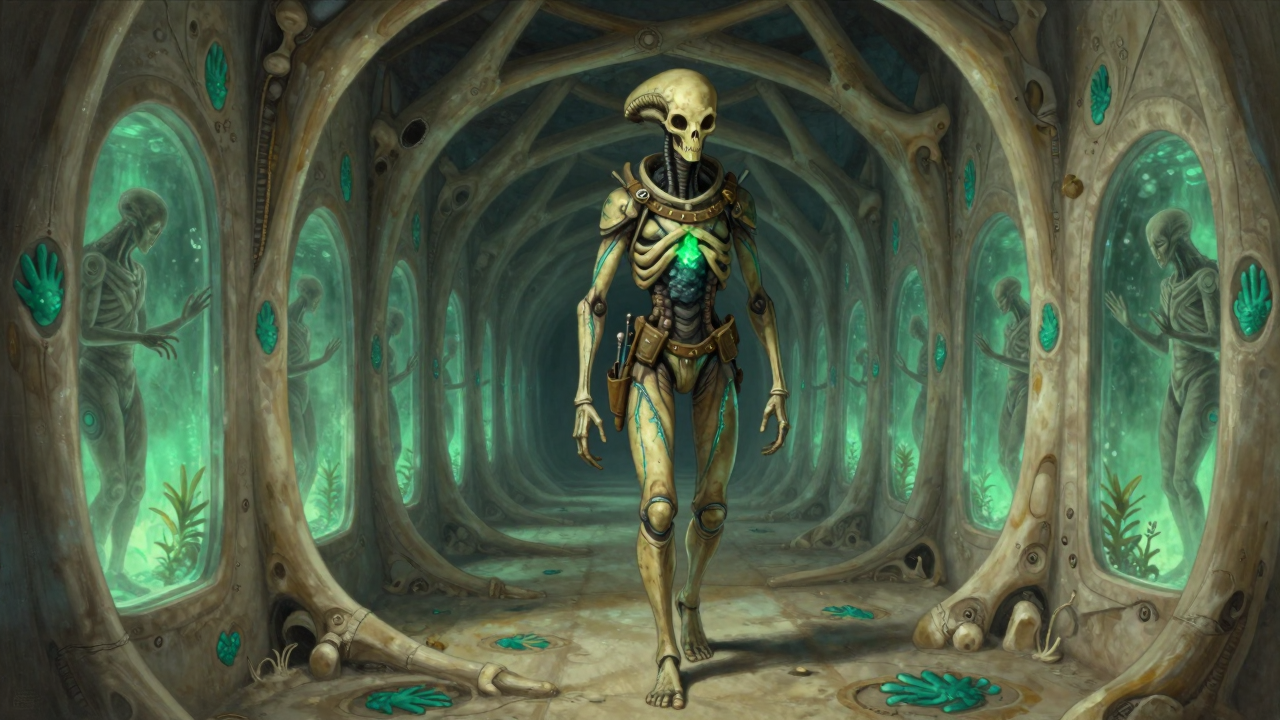
It ran away from them farther than their lamps could carry. On both sides, floor to a ceiling she couldn't find, the bone was grown into cells, each one a tall niche with a clear face, each one filled with green light like pond water with the sun in it. Thousands. In every one a shape stood or sat or lay curled, and she kept her lamp off them after the first, because the first had been reaching for a thing that wasn't there anymore.
Beside each cell was a patch the size of her palm, set into the bone. A label. She had thought so at once, and she had thought writing, and then she saw that none of them were written. They were skin. Each one glowed teal, and each one pulsed, and no two she could see were pulsing alike.
"God Almighty," Brannock said. Then, in her filing voice, the one she used for the suit recorder: "Interior consists of storage cells, number unknown, contents organic, preserved. Labeled." She swung her lamp down the row. "It's a catalog."
"It's a tomb."
"You don't label a tomb like this. You don't keep the lights on in a tomb." Brannock was breathing fast, and Nola knew the sound, it was the sound of sums. "You don't inventory a graveyard, Kettering. You inventory stock."
"Whose?"
A light came on at the end of the row.
It came on all at once, a body's worth of it, teal in every vein and a green coal burning in the middle of the chest, and it was walking. Nola's lamp found it late. It was tall, taller than the hall's first cells, long in the arm, and it went on two legs, and its head was heavy and plated in bone that swept back like a helmet, but nobody had put that helmet on it. The skin under the plates was pale enough to see into. It wore a harness across the chest, hung with pouches, and thick pads strapped at the knees.
Its feet were bare. They came down flat on the bone, one and then the other, and each time one landed she watched the whole foot spread.
"Soldier," Brannock said. "Look at the rig on it. Get behind me."
Brannock had the torch up. She thumbed it, and the flame stood out a foot long, blue-white, and the thing stopped as if it had been called by name.
Its light jumped. It went up the chest and into the throat and out along the arms, brighter, and faster, well past the slow nineteen in the walls.
"It's charging something."
"You don't know that."
"I know what it looks like."
Nola didn't know what it looked like. That was the trouble. The thing lifted one foot clear of the floor and stood on the other, balanced, the lifted sole turned toward them like a held-up palm. She had seen that before somewhere. It took her a second to place it, and then her left hand twitched at her side. It was what she did with the pickups, against a hull. It was listening.
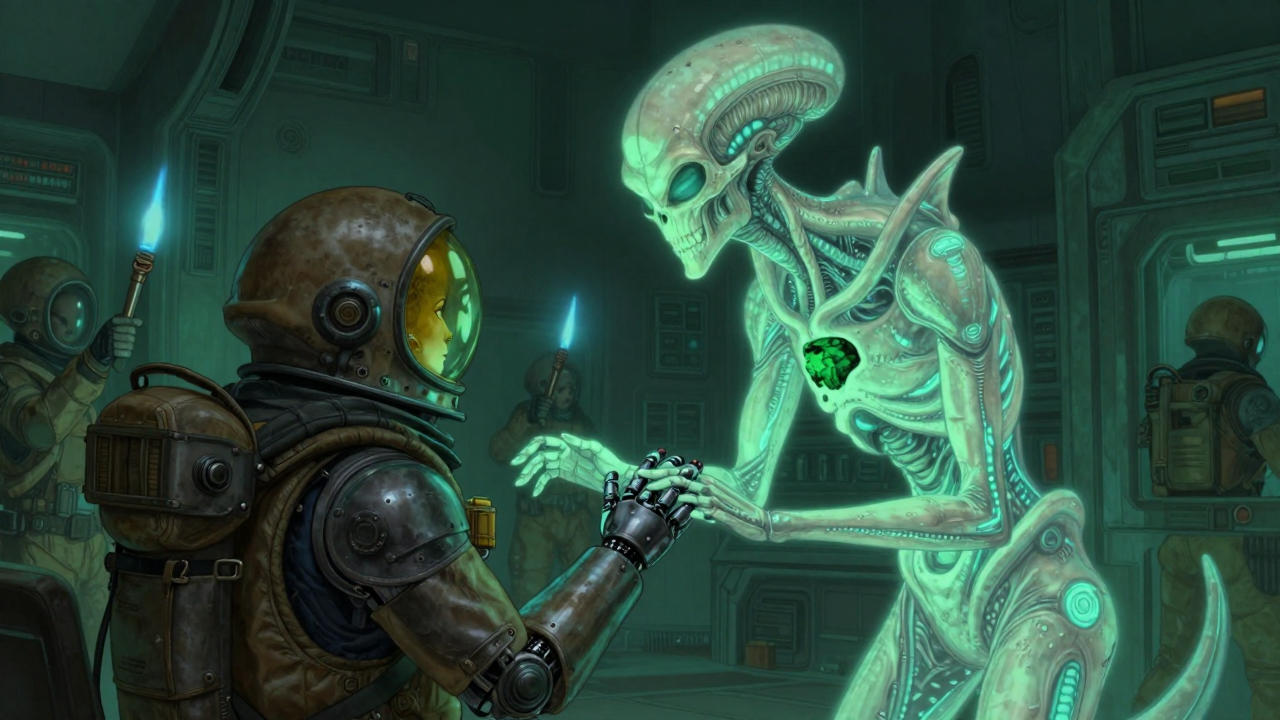
It set the foot down and came on. Brannock's torch followed it. It walked straight past the flame, close enough that the white of it lit Brannock's faceplate, and stopped in front of Nola, and bent, and laid three long fingers on her metal arm.
***
They have faces that answer.
That is the first thing, and it nearly stops Kthiix's heart with gladness. The two dark ones stand in the hall of the kept with their bodies cased from crown to sole in hide that gives off nothing, dead hide, made hide, and Kthiix shines at them everything it has, who and welcome and how are you walking, and in the smooth gold fronts of their heads the whole of it comes back. Every color. The same beat. Kthiix says a thing and the faces say it too, at once, without one flaw.
No two people ever agreed so well.
The larger one speaks from its hand. A tongue of light, blue-white, the single hottest color there is, held out stiff at the end of the arm. It is the mouth that ate the wall. Kthiix knows that from the smell of it, and forgives the wall at once, because here is the answer to all that singing. A people with one word, and they have been shouting it. They could not sing back, so they cut their way in shouting here, here, here. What else would a dark people do, to be found?
It lifts a foot and reads them through the standing one. Two weights. Two hearts, both quick, the quickness of travelers. No lie in the floor. Feet cannot lie either, though these feet are cased so thick that what comes through is small, as if they stood a long way off.
And the smaller one is not the same on both sides.
Kthiix goes to it. It passes the shouting hand, which follows, still saying here, and it bends and lays its fingers on the smaller one's arm.
Cold. Colder than the floor. No pulse in it, no heat, no light, and under the surface nothing at all, the plain grey silence Kthiix has pressed its sole against at ten thousand cells. It is a dim limb. It is the dimming itself, hung from a living shoulder.
The fingers at the end of it open. They close. One by one they tap against the creature's thigh. One, two, three, four.
Kthiix's knees go. The pads meet the floor. It kneels in front of the small dark one with its hand on a dead arm that moves, and its light does a thing it has not done since the hall-mates stood up in the mornings. In the gold face above it, the same light comes back.
They are dark all over and they walk. They are dim and they are not stopped. Whatever took Vethzyr took these long ago, took every one of their people, and they got up.
They know how.
Kthiix stands. It has never gone down this hall fast. It goes fast now, and stops, and turns, and shines come, and the faces say come.
***
"It's herding us."
"It's walking and looking back," Nola said. "That's leading."
"Toward the boxes." Brannock's voice had gone flat and careful. "Count the full ones, Kettering, and then tell me what it wants with two more."
But she came. The torch stayed lit in her fist, and the thing kept turning to look at it and brightening when it did, and every time it brightened Brannock's arm got stiffer.
It stopped at a cell nine from the end. It stood on one leg and put the other sole flat against the clear face, and it stayed like that, like a heron.
The thing inside was one of its own. Nola hadn't seen that in the first cell, or hadn't let herself. The same plated skull, narrower. Long hands, one of them resting on its hip as if it had been about to say something sharp. Armor on it, real plate, the kind somebody puts on. But the skin was grey as a wasp's nest, shut and dull, without one lit vein in it.
Except the throat. There was a line there, blue, thin as a wire.
The live one's chest changed. The wild fast light dropped out of it, and what was left was a slow pattern, repeated. Long. Short, short. Long.
Nola looked at the patch of skin beside the cell. Long. Short, short. Long.
In the cell, the wire of blue at the grey throat swelled, and faded back.
Her knees understood before the rest of her. She put her right hand on the bone wall to stay up.
"Ida."
"I see it. One of them's still got charge, that's a live specimen, that's—"
"It's a name. That patch. It's saying the name and the one inside heard it." Her voice was coming out wrong, and she made herself slow down. "They're not labels. Nobody's stock. Look at its knees, look at the pads. It's not a soldier. It kneels down for a living. This is a ward, Ida. These are its sick. Every one of these is somebody."
Brannock didn't answer. Her gold visor was turned to the cell, and all Nola could see in it was green.
"Then it's a ward nobody's filed on," Brannock said at last. Her voice wasn't hard. That was the worst part. "I'm not a monster, Kettering. I'm eleven months behind. One of these, intact, with the light still on in it, and the Due's ours free and clear and you've got a share that buys you a hand with nerves in it. I'm not taking the place. I'm taking one."
"It'll kill you first."
"Will it?"
The thing had come back to Nola. It took her metal arm in both hands, gently, the way a person lifts a bird, and carried it to the face of the cell and held the steel palm against the glass, over the grey one's heart. Then it looked at her. Its whole body was shining. It lit her arm and the cell and the bone ten meters each way.
She knew what a face meant that looked like that. She had seen it in corridors outside surgery.
"Oh, no," Nola said. "No. No, it thinks—"
She shook her head. It watched her helmet turn from side to side and did nothing. She pulled the arm back and held up her flesh hand, palm out, stop, and it studied the glove, and then the lifted sole of its own foot, and brightened.
There was one true thing she could show it. She reached across with her right hand, found the collar at her left shoulder, and broke the coupling.
The arm came off. It always took a second for the fingers to quit. She held it out in her good hand with the dead weight of it hanging, a tool, a made thing, steel and wire and nobody home. Look. It's not healed. It was never healed. This is what we do instead.
The light went out of the alien so fast she thought she'd killed it.
Then she understood she was one-armed on a salvage site with a cutter running behind her, and she did what her body knew to do. She set the arm to the collar and locked it. The fingers woke. One, two, three, four against her thigh.
The alien made no sound. None of this had any sound. But it came up from the floor of itself like a furnace door opening, white from throat to heel, and it turned to the wall beside the ninth cell and put both hands into the bone.
***
It can be taken off.
The dark one takes the dim limb from its own body and holds it up, stilled, as stopped as anything in the hall, so that Kthiix will see there is no trick and it is truly the dimming. Kthiix's light fails at the sight. It cannot help that.
And then the dark one puts it back and it lives.
So that is the craft of them. They do not cure in place. They carry the dimmed part away and wake it elsewhere and return it. Of course they must take Vethzyr with them. Of course the larger one has stood all this while with its hand shouting here, patient, beside the cell. Kthiix has been slow, and they have been kind about it.
It puts its hands into the wall and asks Leuphana to let go.
She does not want to. The root of a cell goes down into the first-grown, into the elders, and what Kthiix is asking is for old bone to part from a thing it has fed since before Kthiix was budded. The vein behind the cell clenches. The pulse in the floor stumbles and comes back hard, and for a moment every lit thread in the hall says no at once.
Kthiix shines at her what it has seen. The dead arm, lifted off. The dead arm, moving. It has no other argument and does not need one. Leuphana reads her keeper the way everything of their kind reads everything else, wholly, and what Kthiix feels she feels.
The root opens. The vein draws back out of the cell like a hand out of a sleeve, and seals itself. The cell stands free on the floor of the hall. Its green begins at once to thin, having now only what it holds.
Hurry, then.
Kthiix lays its chest against the cell's face and says the name, long, short, short, long, and under it the other thing, the one that has been true at every waking and was never once answered: still here, still here. The blue at Vethzyr's throat does what it does.
Then Kthiix takes one end of the cell. The larger dark one, after standing a moment with its face full of Kthiix's own gladness, puts away its shouting hand and takes the other.
They carry Vethzyr down the long hall, past the cells of the kept. Kthiix shines the news to every one as it passes, in case they can hear: one is going to be woken. They know how. They are coming back for you. The gold faces say it too.
At the wound in the outer lattice the dark ones have a cradle of cold struts waiting, and a line, and beyond the line a thin hard ship with fire at its tail. Kthiix sets its end down. It lifts one foot and reads the small one a last time through the floor.
The heart in it is going very fast, and the weight keeps shifting back, and the dim hand is tapping, tapping, tapping. Kthiix knows what that is. It has felt it in its own feet, at the start of every waking, in front of the first cell of ten thousand. That is how a keeper stands when the work is larger than the keeper.
It touches the cold arm once more. Then it steps back from the wound so Leuphana can close.
***
Nola watched the cut seal from the end of the tether. The bone closed the way a wound closes, not fast, not violent, just finished. The ring they had burned was a seam. The seam was a scar. The scar was bone.
The Due burned for Ceres at a quarter g, and the cell rode in the truss bay under four straps and a tarp Brannock had thrown over it to keep the light off the cameras.
Nola took the tarp off.
She had not said a word since the hall. She had carried nothing and stopped nothing. At the cut, when it stood on one leg in front of her and touched her arm, she could have done any of a dozen things, and the hand had gone one, two, three, four and her mouth had stayed shut, and now they were nine hours out.
Up the companionway Brannock was on with the claims office. "One container, intact," she was saying, in the filing voice. "Contents organic. Possibly viable. No, no resistance. The site was unattended." A pause. "Derelict. That's what I filed and that's what it is."
The green in the cell was the color of weak tea. The figure inside stood with its hand on its hip in the bad light, sure of the next thing. Nola got down on the deck plates in front of it. She pulled off her right glove, and after a moment she unlaced her boots, and peeled her socks, and set her bare feet on the steel. It was cold enough to hurt.
She put her right palm on the glass. Then she put the left one beside it, though it would tell her nothing, and watched the strip on her forearm instead.
A flat line. A flat line. A flat line. Then a hill so low she might have drawn it herself by wanting.
Out the bay's one port, the thing they had left was still in sight. It should have been a speck. It was not a speck. Every vein in it had come up, strut and spine and hollow, the whole reef of it blazing teal against the dark so that it threw a shadow of the Due's truss across the bay wall. Three bright inside the long, over and over, end to end, the way it had sung them in. It had been like that for nine hours. It would be like that, she thought, for as long as there was a line of sight between them, and then it would go on, in case.
It could not have hidden it if it tried. It had never in its life had to try.
Nola unclipped the lamp from her collar. She cupped it against the cell's face, over the grey throat, and worked the switch with her thumb.
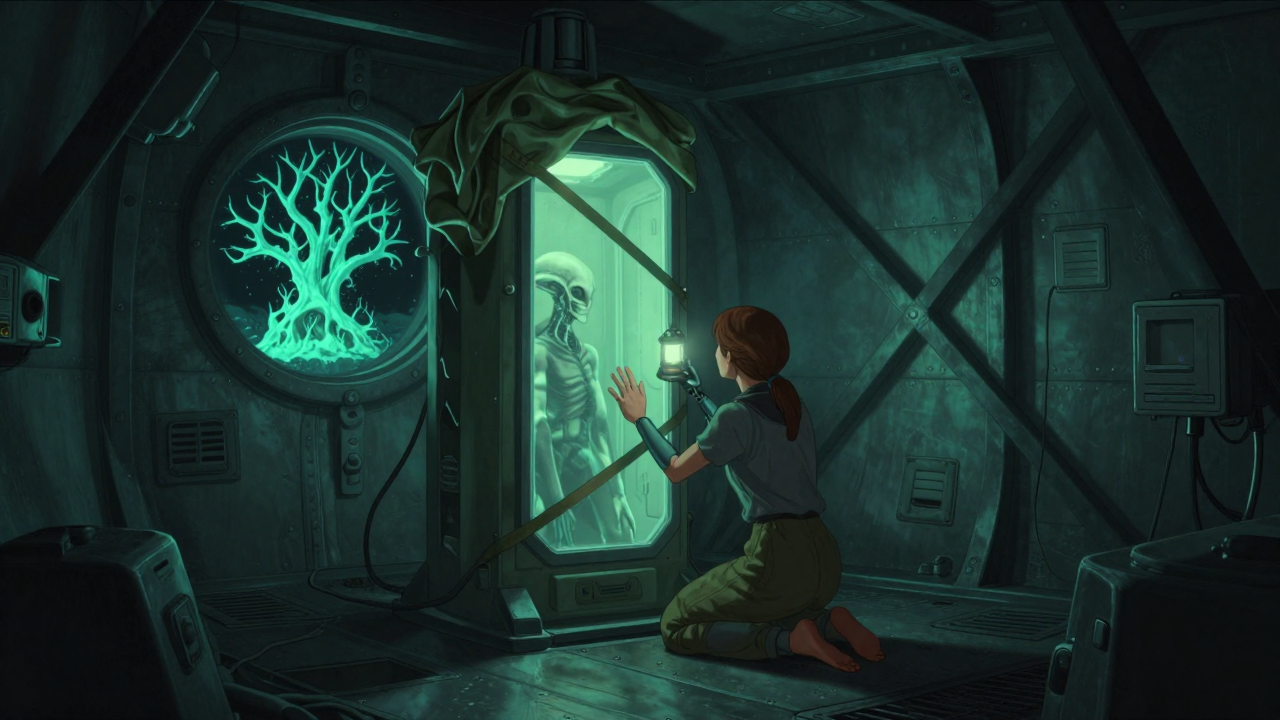
Long. Short, short. Long.
It was the only word she had of theirs, and it was somebody's name.
She said it again. She said it until her thumb cramped, and changed hands, and found that the metal thumb kept better time. Up the companionway the filing voice went on. Behind her, on the wall, the truss's shadow held steady in that far glad light.
In the cell, at the throat, the wire of blue came up once. She was almost sure of it.
Long. Short, short. Long. Still here.